Yes, you can get both hips replaced at the same time. It is also called bilateral hip replacement. If you are having problems with both hips, your doctor will recommend a bilateral hip replacement if you are in good health and can tolerate surgery on both hips.


Table of Contents 
- Synopsis
- Introduction
- What is Total Hip joint replacement surgery?
- Types of Total Hip Joint Replacement Surgery
- Why is total hip joint replacement recommended?
- The Procedure of Total Hip Joint Replacement
- Risks and benefits of Total Hip Joint Replacement
- Why choose Gleneagles Hospital for total hip joint replacement?
- Conclusion
Synopsis
A hip replacement is a medical procedure to surgically replace the hip or parts of it with an artificial implant. It is also called arthroplasty. This article will give you complete information about hip replacement surgery. Learn everything about total hip joint replacement surgery from the renowned and trusted Gleneagles Hospitals.
Introduction
Hip replacement is a complex surgery in which complete or parts of the hip joint are replaced with chosen implants. This type of surgery helps to relieve pain & improve mobility in patients suffering from chronic arthritis, fractures, or other hip-related diseases. You must choose the best hip replacement surgeon to get the best results. Gleneagles Hospital is the best hip replacement hospital.
What is Total Hip joint replacement surgery?
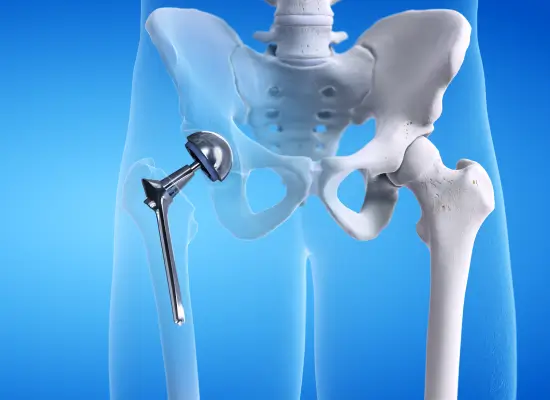
Hip joint replacement surgery is the removal and replacement of diseased parts of the hip joint with manmade implants. The surgery is mainly done to relieve pain and stiffness of the hip joint caused by arthritis, fracture, or any other disease.
Types of Total Hip Joint Replacement Surgery
The two types of total hip joint replacement surgery are:
- The anterior approach: In this anterior approach, the surgeon will make an incision on the anterior or front of the hip. It is a minimally invasive approach and there is less risk of dislocation.
- The posterior approach: In this posterior approach, the surgeon would make an incision on the posterior or back of the hip. It is the most common type of total hip replacement surgery, but there is a higher risk of dislocation.
Your health matters – get expert advice today.
Why is total hip joint replacement recommended?
Total hip joint replacement is recommended when symptoms make it difficult for the patients to perform daily activities. It is also recommended when conservative treatments like medications, injections, and physical therapy fail to give relief. Common indications for a total hip joint replacement include the following:
- Rheumatoid arthritis: It is an autoimmune disease causing pain, swelling, inflammation, and destruction of bones.
- Osteoarthritis: It is the most common reason to recommend THR because cartilage wears down, and it causes extreme pain and stiffness in the joint.
- Hip fractures: People suffering from severe hip joint fractures may need total hip joint replacement to reduce pain.
- Avascular necrosis: It is a condition in which the blood supply to the femoral bone’s head is compromised, causing bone death and joint weakness.
- Hip dysplasia: It is a congenital problem in which the hip socket is too shallow, causing joint instability and arthritis.
- Bone tumours: A person suffering from tumours of the bones forming the hip joint will also need THR.
The Procedure of Total Hip Joint Replacement
Before surgery:
You have to book an appointment with a hip replacement doctor at Gleneagles Hospitals. Your concerned surgeon will do a physical examination and some blood tests. He will ask about your symptoms and take your medical history. The doctor will move your hip to assess your range of motion. It will also help him to check the strength of the muscles supporting the hip & leg.
The doctor will recommend certain tests, such as:
- Hip X-rays
- Blood tests
- Urine analysis
- MRI
- CT Scan
- ECG
During the procedure:
Total hip joint replacement will take about one to two hours. It includes the following steps:
- The doctor will give you general anaesthesia to make you sleep during the procedure.
- The doctor will make an incision to access the hip joint. The doctor will make an incision either in the front or back of the joint, depending on your condition.
- The damaged or diseased part of the joint is cut and removed.
- The hip socket is reshaped and filled with an artificial cup. The femoral stem and head are placed and secured after ensuring stability and proper range of motion.
- The incision is closed with sutures or staples.
After the procedure:
- After the procedure, you will be shifted to the recovery room.
- You may have to stay in the hospital for 1-3 days, depending on your recovery speed.
- The doctor will give pain medications to control pain after the procedure. Patients are encouraged to walk with assistance after one day.
- Physical therapy is recommended to strengthen muscles and restore early movement.
- Ensure you have proper arrangements at home, such as raised toilet seats, grab bars, and mobility aids.
- You have to visit the hospital for regular check-ups so that the doctor can monitor your progress.
Risks and benefits of Total Hip Joint Replacement
Benefits:
- Hip replacements are successful surgeries, and most people live pain-free lives.
- After complete recovery, you should have increased mobility and range of motion.
- It becomes easier to perform your daily activities, such as walking, climbing stairs, and performing other physical activities.
Risks:
- Infection at the site of incision
- Blood clots form in the legs or lungs
- Loosening or dislocation of prosthesis
- Fracture of bones around the implants
- Stiffness in the joint
- Leg length discrepancy
Why choose Gleneagles Hospital for total hip joint replacement?
Gleneagles Hospital is the best multispecialty hospital that offers total hip replacement. You can consult with the best hip replacement surgeon at Gleneagles Hospital. The reasons for choosing this hospital are:
- Expertise in orthopaedic surgery: Gleneagles Hospital has a team of experienced and dedicated orthopaedic surgeons specialising in joint replacements. They make an accurate diagnosis and tailor treatment plans based on the patient’s condition.
- Advanced techniques and modern technology: The hospital is well-equipped with advanced techniques and modern technology. The doctors use robotic-assisted hip replacement surgery to reduce trauma and improve success rates. The doctors also use 3-D imaging and a computer navigation system to ensure accurate alignment of the implant.
- Comprehensive preoperative and postoperative care and treatment: The hospital offers a patient-centric approach to ensure that every patient receives personalised care throughout the treatment. The hospital offers the best preoperative and postoperative care to the patients for quick recovery and successful results.
- Rehabilitation and physiotherapy: Total hip joint replacement needs postoperative rehabilitation and physiotherapy to regain mobility and strength. The hospital has a well-equipped physiotherapy center with expert physiotherapists who make tailored rehabilitation programs based on the specific needs of the patients.
- Affordable treatment: Gleneagles Hospital offers affordable total hip replacement surgery. The hospital also has insurance and financial assistance for eligible patients. There is no hidden cost, and pricing is transparent.
Conclusion
Total hip joint replacement surgery is a surgical procedure to improve pain, mobility, and overall quality of life. Advancements in medical science and surgical techniques have made it possible to achieve successful results in THR. You must consult with the best hip replacement doctor at Gleneagles Hospitals to get the best results. You can regain full function and can lead an active life with proper follow-up and care after total hip joint replacement.
Frequently Asked Questions
Q1.Can I get both hips replaced at the same time?
Q2.What precautions should I take after THR?
Your Hip Replacement doctor will give you instructions at the time of discharge from the hospital:
- You must keep the surgical site clean and dry. Your doctor will give you instructions for bathing.
- Take medications as instructed by the doctor.
- Visit the hospital for a regular follow-up so that the doctor can monitor your progress.
- Attend physical therapy sessions and perform exercises at home.
- Resume your daily activities slowly as instructed.
- Eat a high-protein diet to recover quickly or as instructed by the doctor.
- Elevate your leg and use ice to prevent swelling.
- Avoid driving until your doctor recommends you to drive.
Q3.What are the parts of a hip joint replacement prosthetics?
The hip joint replacement implant is made of two parts:
- A ceramic ball is attached to a metal stem and inserted into the thigh bone or femur for stability. Earlier, a metal ball was used.
- A metal cup made of titanium has inner plastic layers. It is attached to the socket part of the hip joint to allow the replaced joint to move and rotate smoothly.
Q4.What is the recovery time for total hip joint replacement surgery?
The recovery time varies from patient to patient, depending on age and other factors. Generally, the patient has to stay for 1-3 days in the hospital. You can start walking using assistance within 24 hours after surgery. You can resume daily activities in 6-12 weeks. Full recovery may take up to 6 months. You must attend physical therapy sessions regularly to recover quickly. Regular exercise and physical therapy helps to regain stability and strength.
Q5.What activities should I avoid after total hip joint replacement?
- You must avoid high-impact sports such as running, jumping, and heavy weightlifting after hip joint replacement.
- You should also avoid twisting or pivoting movements on the operated hip joint.
- You can take part in low-impact activities such as swimming, walking, cycling, and yoga after getting a clearance from your doctor.